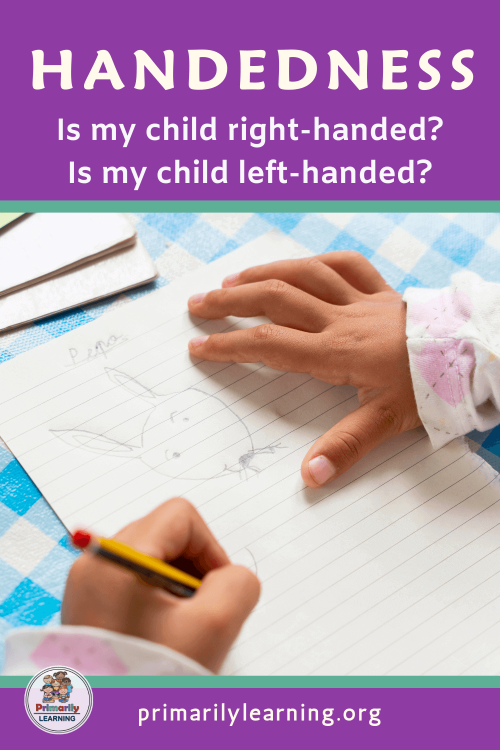




How Do I Know if My Child is Right or Left-Handed?
Hand preference typically emerges when your toddler begins to use a spoon or other writing tools. As parents observe their child, they may begin to wonder whether he will be right- or left-handed and how much influence they have over his hand dominance. Research shows that “… by the eighth week of pregnancy, genes in the baby’s spinal cord already show the beginning of right-left preference – before the connection between the spinal cord and the brain is fully formed.” The unborn baby’s spinal cord is where hand preference starts! Have you seen an ultrasound of a baby in the womb sucking a preferred thumb?
You likely watched your baby use both hands to reach for toys and food. Reading and grabbing do not require specific muscles. Often, babies will use the hand closest to the toy that they are trying to get! As fine motor skills develop, hand dominance is more obvious.

Children may begin to demonstrate a preference for right- or left-handedness around 18 months of age, with a more pronounced hand preference by 3 years of age. Switching hands may still occur because the hand muscles become tired. Right- or left-hand dominance is usually well-developed by kindergarten (ages 4-5) and fully developed by First Grade (ages 5-6). (Reference: Better Health Channel)
Why does it matter which hand is dominant?
- In kindergarten, your child will have numerous opportunities to draw, write, paint, and create crafts. Encouraging the child to use the hand that appears dominant will increase practice and improve the child’s performance.
- Since approximately 90% of the population is right-handed, left-handed individuals often encounter practical problems. (e.g., modeling pencil grip, scissors, learning to use utensils, or tying a shoe!)
How should a right-handed or left-handed person hold the pencil?
My sister uses her left hand. Our knowledge and awareness of handedness have improved over the years. Because English writing runs left to right, Cathie learned to ‘crab’ her hand as she wrote… to avoid smudging the ink. Today, we know that both right and left-handed children should hold the pencil with a tripod grip.

Suggestion: Ask the child to wiggle his fingers, then hide the last two fingers from the thumb by tucking them in toward the palm. Hold the pencil with the thumb and first finger. Make the knuckles move in and out just like “froggy legs.” Use the third finger as a “log” for the frog to sit on (so the pencil does not fall to the ground). This position is suitable for both right-handed and left-handed individuals.
Modeling for Right or Left-handed People is Important
- If you demonstrate writing, eating with a fork, tying a shoe, etc., please remember that modeling is essential.
- As a right-handed parent or teacher, modeling is particularly effective for right-handed children. But, if you are modeling for a left-handed child, use your left hand … and don’t rush! (The reverse is true for left-handed parents and teachers!)
- Just picture a “southpaw” trying to mirror a right-handed person recording letters and sounds … or demonstrating how to tie a shoe!
Mirror Writing
Sometimes left-handed children learn to write ‘back to front (mirror writing). “This is a natural inclination, not a sign of dyslexia, and will resolve given time, practice, and encouragement.”
Right and Left-handed Scissors
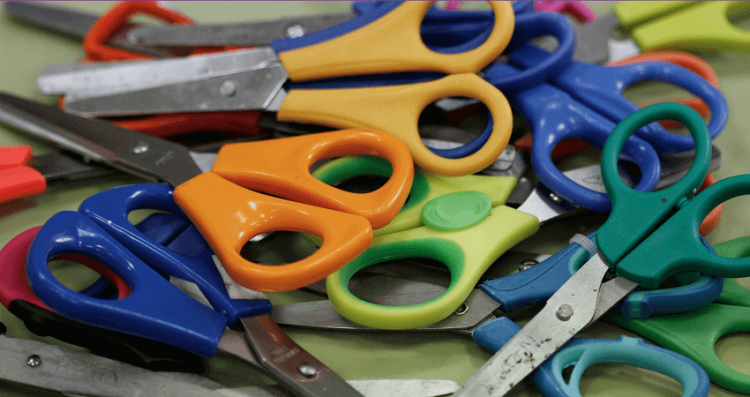
- When a child enters kindergarten, the teacher assesses hand dominance to maximize learning opportunities for each student. Schools have both right and left-handed scissors. Have you ever tried to use right-handed scissors in your left hand?
- Home and school should provide left-handed learners with scissors designed explicitly for left-hand use. Right-handed scissors have the sharper part of the blade on the left side. A left-handed person will try to use them with their left hand. Frustration sets in because the dull part of the blade won’t cut the piece of paper or string. (Even though the child is trying to do as asked.) Imagine how that child feels through no fault of his own! The scissors do not work!
Bonus for Lefties!
Left-handed people are often at an advantage in a wide range of sports! Why? It could just be the unexpected left-hand follow-through. (e.g., tennis, baseball)
Right or Left Hand Preference Assessment
- The following activities are often used in a kindergarten classroom to determine whether a child is right- or left-handed.
- This is still a good guide, but please note: the Better Health Article states that while “It was once believed that a right-handed person has a general dominance on the right side of their body, which means they favored foot, eye, ear on their right side, it is now known not to be the case. Many people may be right-handed but take their first step with their left foot.”
- They determined that the more we discover about right and left-handedness and their links to brain function, the more we realize we don’t know. Your child may throw a ball with their right hand, use their right hand cupped to their ear to listen more intently, but kick with their left foot!

Directions
- If hand preference is not apparent, you may want to observe the child’s response to some or all of these activities.
- For each activity used, check whether the child uses the right or left side.
- When you have completed the activities you’ve chosen to use, review the results.
- If you need to clarify your observation of the child’s hand preference, pick one task from each grouping.
- Optional: Randomly introduce and observe one or more of these tasks throughout the week. Record the results.
Equipment
- small ball
- toilet paper roll
- cup of water
Hand/Arm
- Place a plastic/paper cup of water in front of the child. Ask the child to pick up the water as if to drink it. Did he use his right hand or his left hand?
- Place a soft ball in front of the child. Ask the child to pick up the ball and throw it! Did he use his right arm or his left arm?
- Put your hands behind your back, with one hand holding the other. Which hand is doing the holding?
- Imagine a bee is flying toward your face. Which hand do you use to shoo it away?
Eyes/Ears
- Place a toilet paper roll in front of the child. Ask the child to pick up the tube and look through it. Did he use his right hand or his left hand? Which eye was used to look through the empty tube?
- Ask the child to pretend to be a pirate! Close one eye. (Optional: Use your thumb and index finger to create a telescope.) Which eye was kept open?
- Pretend you are hard of hearing. Cup your hand to your ear to make the sound louder! Did he use his right hand or his left hand?
Foot/Leg
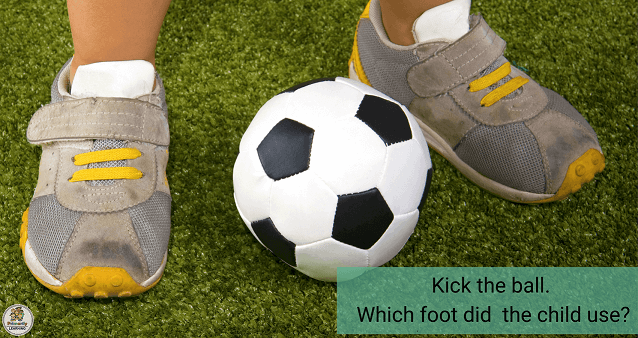
- Place a ball on the ground in front of a child. Ask the child to kick the ball. Did he use his right foot or his left foot?
Remember: Handedness is not always straightforward. People can still perform various tasks with either hand/foot.
Share Your Story
- Have you had any personal experiences with handedness?
- Do you have any ideas or stories to share about working with children as they discover their dominant hand?
- If you have a minute, please share them in the comments below. I’d love to hear from you!
If you are a left-handed adult…check out these tools.
14 Products for Left-handed People. From scissors to can-openers… to pens!
15 Tools Made Especially for Lefties
Check out online stores for left-handed pencil grips, scissors, and pencil sharpeners for kids.
READ MORE research on handedness HERE>>> Half a century of handedness research: Myths, truths; fictions, facts; backwards, but mostly forwards – by Chris McManus