




Phonological awareness is one of the important early literacy skills children need before they become confident readers and writers. This article looks at two helpful assessment tools – the Wepman Auditory Discrimination Test and Jerome Rosner’s TAAS – Test of Auditory Awareness Skills as a way to understand how well children hear and work with sounds in spoken words.
These simple listening tasks can help teachers notice which students may need extra support before phonics instruction becomes more difficult. You’ll also find a few easy classroom activity ideas to help children “train their ears” for reading success.
Before children can connect sounds to letters, they need to notice whether words sound the same or different, hear beginning and ending sounds, and understand that words can be taken apart and put back together. When we catch listening or sound-awareness difficulties early, we can provide short, targeted practice for individual students before small struggles become bigger reading and spelling challenges.
Phonological awareness is not about print yet – it is about helping children hear the sounds in words so they are ready to understand how the alphabetic code works.
1. Wepman Auditory Discrimination Test – Phonological Awareness Assessment
Full name: Wepman’s Auditory Discrimination Test
Main skill: Auditory discrimination
Purpose: To see whether a child can hear if two spoken words are the same or different.
The Wepman Auditory Discrimination Test is a formal assessment that looks at how accurately children hear differences in spoken words. The examiner reads pairs of words aloud, and the child indicates whether the words are the same or different. The current published version includes 40 word pairs and is designed to measure children’s ability to hear spoken language accurately.
Teacher-friendly explanation:
This matters because children need to hear small differences in words before they can confidently connect sounds to letters. If a child does not hear the difference between pat and pot, or rain and train, spelling and reading can become more difficult.
Classroom use:
Practice hearing words as a class and deciding if they are the same or different. Ask, “What’s different?” e.g., pat / pat; stop / step; pan / man;three / tree; rain / train; can / cat; crack. crane/ shed Do this activity as a quick oral warm-up.
Children do not need to see the words. This is about listening, not reading.
A quick sample assessment:
Directions: Ask the child to sit, facing forward, in front of you. Tell the child that you are going to play a game where he/she has to listen with his/her ears. Say, “Listen carefully to the words I say, and tell me if they sound exactly the same or different.
(Adapted from Wepman Auditory Discrimination Test)
- king / king – same
- cap / cup – different
- web/ wed – different
- coat / goat – different
- lack/ lack – same
- shape / shake – different
- pat / pot – different
- tin / pin – different
- dog / dog – same
- thread / shred – different

2. Rosner TAAS – Phonological Awareness Assessment
Full name: Test of Auditory Analysis Skills
Author: Jerome Rosner
Main skill: Auditory analysis / phonological awareness
Purpose: To see whether a child can hear, identify, and manipulate parts of spoken words.
Rosner’s Test of Auditory Analysis Skills is often described as a quick phonological awareness measure. It looks at whether children can identify the separate sounds in spoken words and understand the order of those sounds. One common task asks children to delete part of a spoken word and say what is left.
Teacher-friendly explanation:
This is a deeper listening skill than simply saying whether two words are the same or different. Children have to listen inside a word, remove a sound or word part, and then say what remains.
Examples for informal practice:
Say: sunshine.
Say it without shine.
Child says: sun.
Say: cupcake.
Say it without cup.
Child says: cake.
Say: brush.
Say it without /b/.
Child says: rush.
Say: smile.
Say it without /s/.
Child says: mile.
Say: train.
Say it without /t/.
Child says: rain.
Note: This is an oral activity. The goal is not spelling. The goal is listening to the sounds in spoken words.
Classroom Activities to Help Train the Ears – Teacher Reference
This post may help teachers and parents understand why some children struggle with listening, remembering sounds, following directions, or hearing small differences in words—and offers practical ways to support auditory processing skills in early literacy. Help! I Need Practical Auditory Processing Ideas!

“Bag of Objects” Listening Game to help develop Phonological Awareness
Skill focus: Beginning sounds, ending sounds, auditory memory, vocabulary, oral language
Best for: PreK, Kindergarten, Grade 1, ESL, intervention, small groups
Place familiar objects in a bag, such as:
- cup
- ball
- sock
- car
- spoon
- dog
- shell
- brush
- key
The teacher, parent or a student asks sound questions. They will reach into the bag and hold one object and then provide hints, e.g. “It starts with /d/.” The children make guesses as to what it could be, “Is it a dinosaur?” (Is it a ball?) The teacher, parent or a student continues with: “It ends with /g/.” “It has the /o/ sound in the middle.” “It rhymes with log.” etc. until the object is identified. As soon as the item is correctly guessed, the teacher pulls it from the bag! Students enjoy the role of “being the teacher” for this game.
Why it helps:
This turns phonological awareness into a hands-on listening game. Children are touching, naming, listening, and thinking about sounds.
I created this set of 30 Auditory Processing Task Cards to give my students the extra support they needed. I hope they are helpful for your learners, too.
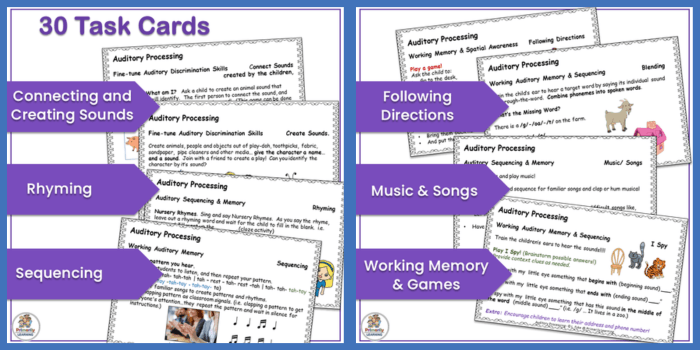
Auditory Processing | Phonological Awareness Activities Discrimination & Memory
“What’s My Sound?” Game
Skill focus: Beginning sounds and ending sounds
Best for: Kindergarten, Grade 1, ESL, phonemic awareness warm-ups
Beginning Sound Version
Say three words with the same beginning sound: dad, dog, door
Ask: “What sound do you hear at the beginning?” Answer: /d/
More examples:
- sun, sock, soup – /s/
- moon, man, mop – /m/
- fish, fan, foot – /f/
- cat, cup, car – /k/
Ending Sound Version
Say three words with the same ending sound: rush, brush, flush
Ask: “What sound do you hear at the end?” Answer: /sh/
More examples:
- bat, cat, hat – /t/
- dog, log, frog– /g/
- map, cup, hop – /p/
- rain, train, chain – /n/
Teacher note: Use sound language, not letter names. Say “What sound do you hear?” rather than “What letter is it?” when the activity is focused on phonological awareness.

Compound Word Take-Away – A Great Phonological Awareness Activity
Examples for informal practice:
Say: cowboy. Now say it again, but don’t say: cow. Child should say: boy. (Every year I have had at least one child respond: horse.)
Say: sunshine. Now say it again, but don’t say: shine. Child should say: sun.
Say: toothbrush. Now say it again, but don’t say: tooth. Child should say: brush
Say: train.
Say it without /t/.
Child says: rain.
Classroom use:
This is an oral activity. The goal is not spelling. The goal is listening to the sounds in spoken words.
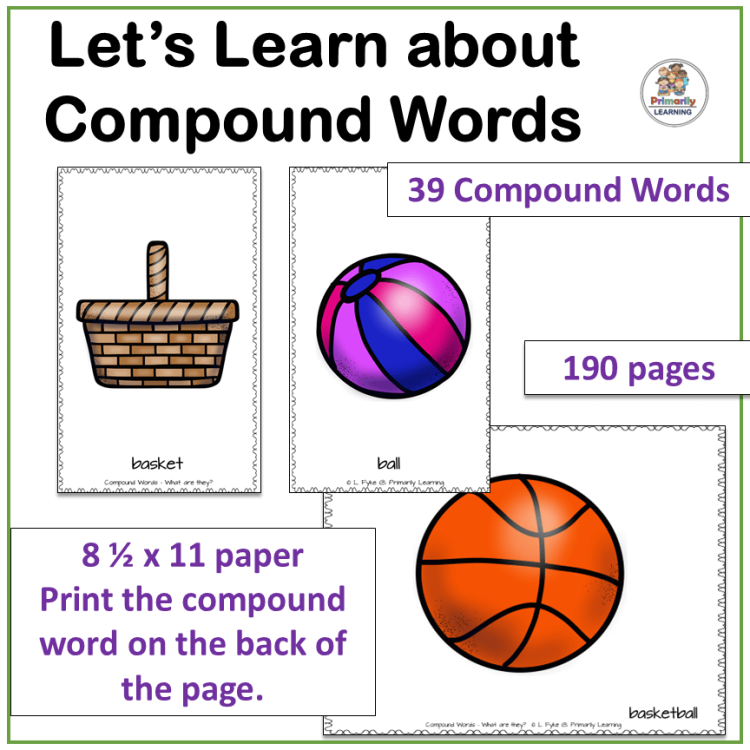
Because some children needed visual support to understand this listening task, I created a set of simple compound word cards. The goal is to “train the ears” to hear and work with word parts. Over time, the pictures are no longer needed, but they provide helpful support while children are learning. This simply gives all students another way to understand the activity and feel successful.
Simple Phonological Awareness Progression for Teachers
You could present the skill progression like this:
1. Same or different?
king/king, pat/pot, rain/train
2. What sound starts the word?
dad, dog, door
3. What sound ends the word?
rush, brush, flush
4. What happens if we take one part away?
train without /t/ = rain
brush without /b/ = rush
sunshine without shine = sun
5. Then connect sounds to letters through phonics.
That progression is very teacher-friendly because it shows how listening skills lead toward reading and spelling.
When we take time to assess phonological awareness, we are not looking for labels – we are looking for clues.
These simple listening tasks help us understand which children are ready to move forward and which children may need more practice hearing the sounds in words. With early support, playful listening games, and explicit instruction, children can strengthen the sound-awareness skills they need for phonics, spelling, and reading. The goal is always the same: to help each child hear the sounds, connect them to letters, and move forward with greater confidence.
Have a great day!
Laurie